
Types of Appling County Deeds
Deed records in Appling County serve different purposes depending on the instrument. The label on a recorded deed is only the first clue. The recorded image carries the operative text, the parties, and the legal description. It also includes any exceptions and the signatures. Through GSCCCA's Appling County search, that image set includes warranty, quitclaim, estate, and foreclosure instruments. It also covers gift, sheriff's, tax-sale, timber, mineral, right-of-way, and other real-estate deeds.
| Deed Type | What It Does | Common Use |
|---|---|---|
| Warranty deed | Conveys land with stated title promises | Ordinary sale or transfer |
| Quitclaim deed | Passes whatever interest the grantor has | Interest release or chain cleanup |
| Deed from estate | Transfers under estate authority | Probate-linked conveyance |
| Foreclosure or sheriff's deed | Records a transfer after a sale process | Distressed-property chain |
| Tax-sale deed | Records a tax-sale transfer | Delinquent-tax proceeding |
Not every recorded instrument is an ownership deed. A security deed, an assignment, a lien, a UCC filing, or a release can affect the property without conveying it. Read the sequence carefully. The YESS Holdings sample shows why: it links a security deed, an assignment of rents, a UCC filing, a plat, and a later sale notice. Each item deserves its own check.
Recorded order matters too. A release or cancellation can answer an earlier security deed. An assignment can shift who holds an interest while the land itself stays with the owner of record. A court order, power of attorney, boundary agreement, or easement may explain a later deed in the chain. Never collapse these instruments into one ownership label.
Search the Appling Deed Index
The official GSCCCA real-estate name search puts detailed controls in front of you before any login. Set County to APPLING. Pick all parties, grantor, or grantee, then choose an instrument family and narrow the date span when a common name floods the results. The site also lets you display five to one hundred results per page in regular or one-line format.
| Field | Choices | Search value |
|---|---|---|
| Party type | All, grantor, grantee | Separates transferor from recipient |
| Instrument | Deeds, liens, easements, releases, and more | Narrows the record family |
| County | APPLING or all counties | Keeps the chain local |
| Name and dates | Name text and optional range | Controls common-name volume |
| Display | Result count and table style | Helps preserve readable book/page data |
The captured GSCCCA form shows those controls before a user submits a query.
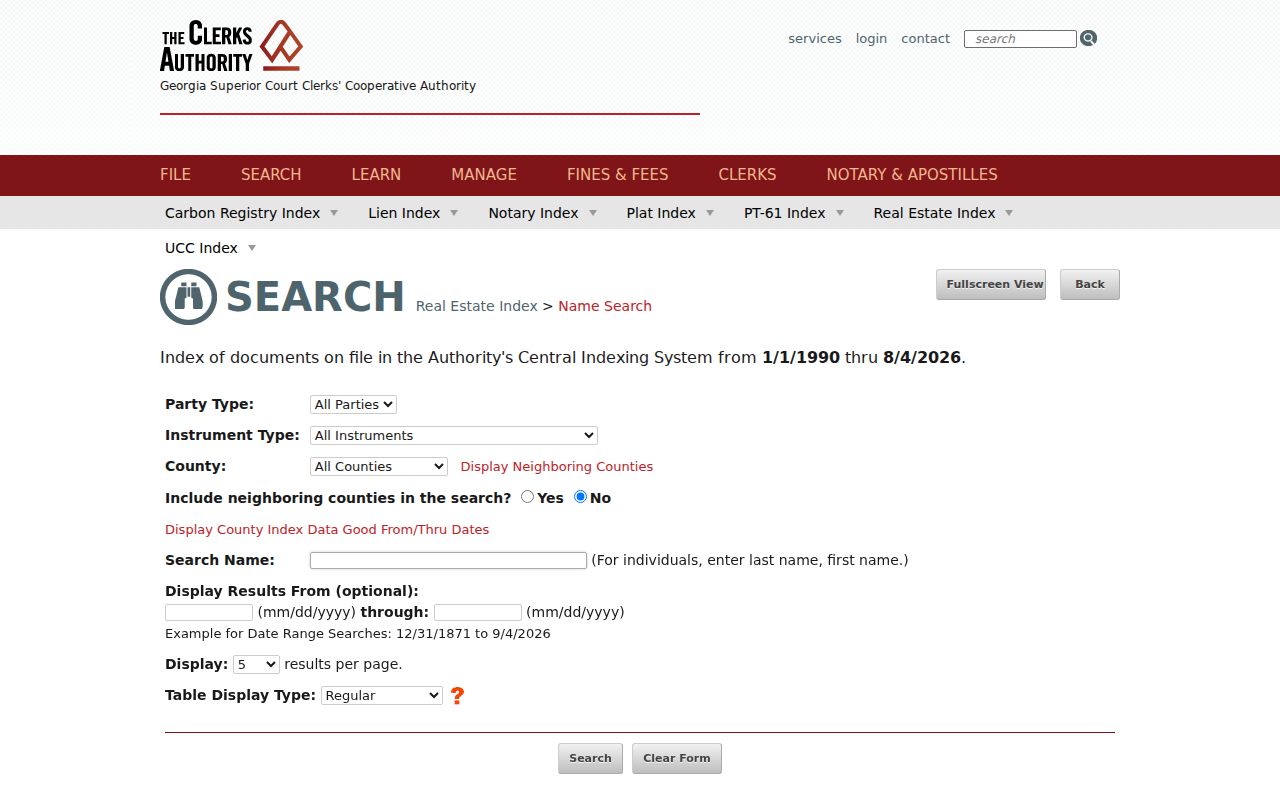
The image shows the search controls themselves. An unauthenticated visit still lands on a login page rather than an Appling result.
Appling Book and Page Clues
A book and page citation is the fastest path to a known instrument. GSCCCA's Book/Page Search takes county, book, and page. One 2026 local notice names a warranty deed. It runs from Dawn Elizabeth Tippins to Forisk Holdings, LLC. The citation is Deed Book 735 Page 143. The same notice ties that deed to 5.740 acres in Land Lot 529 of the 2nd District. It also cites Plat Book 22 Page 762.
Always check the citation against the indexed image or a copy from the Clerk. The notice also references a survey, zoning, easements, and restrictions. That is exactly why a one-line index label can never replace the full deed.
A strong deed abstract captures both execution and recording dates. It lists every grantor and grantee, the instrument label, book and page, any stated consideration, acreage, land lot and district, subdivision data, survey and plat references, and all exceptions. Keep that abstract beside the image. Later chain checks go much faster. The risk of merging two similar tracts drops sharply.
Fairview Deed and Plat Links
Fairview Subdivision opens a second, very different record trail in Appling County. A notice identifies Lots 1 through 12 in Block 2, Land Lot 293 of the 2nd District. The plat sits in Plat Book 1A Page 46. The prior deed sits in Deed Book 300 Page 350. Subdivision, block, lot, district, and plat work together here. Together they separate this land from another tract under a similar owner name.
The GSCCCC Property Search requires a subdivision and includes Appling among participating counties. A Plat Name Search there also accepts county, plat or map type, name, district, land lot, dates, and display controls.
Follow Appling Grantor-Grantee Links
A grantor-grantee index organizes deed records by people and entities. It does not sort by a modern street address. Start with the current acquisition deed. Search the present owner as grantee, confirm the tract, and note the grantor. Then run that grantor as a grantee. That finds the deed by which the prior owner acquired the same Appling County land.
- Find the current owner's acquisition, with that owner shown as grantee.
- Copy the grantor, book/page, date, and full legal-description anchors.
- Search the prior grantor as a grantee, then confirm the same tract.
- Repeat until the online index ends, then move to the courthouse books or microfilm.
- Grantor
- The party that transfers an interest.
- Grantee
- The party that receives an interest.
- Chain of title
- The linked sequence of recorded transfers for the same land.
- Book and page
- The courthouse reference used to retrieve a recorded instrument.
Appling Deeds Before the Web
The FamilySearch Appling catalog opens its deed and mortgage material in 1828. Indexes run through 1914 and volumes through 1918. Not every book survives. Not every image opens online. Even so, it proves a historic route beyond the current portal.
Georgia Archives also records an 1876 record-loss event at the Appling courthouse. The damaged or rebuilt series remains unclear. Ask the Clerk or Archives about the first surviving book and any reconstruction notes. Also ask about the microfilm inventory and the current GSCCCA cutoff. Label the gaps plainly.
Note: A statewide GSCCCA coverage statement never substitutes for Appling County's own index dates.
A 1969 Survey Survives
A February 2026 mortgage-sale notice reaches back through Book 488, Pages 789 through 796. It cites prior Warranty Deed Book 137 Page 493. That deed rests on a David Hutto survey dated June 19, 1969. The tract covers 0.799 acre in Land Lot 426 of the 3rd District. Old evidence can survive inside a brand-new publication.
The lesson is precise. The date of an online notice is never the start of the chain. Record each cited survey and prior deed. Then pull the source instrument before drawing any title conclusion.
Appling Deed Access Channels
Marsha Thomas heads the Clerk of Superior Court. That office is the county's recorder. You'll find it at 69 Tippins Street, Suite 103, in Baxley, open weekdays from 8:00 a.m. to 5:00 p.m. Deeds, liens, UCCs, and plats can be filed through GSCCCA or manually by mail or at the counter. The published $25 figure is a real-estate filing fee, not a copy price. No complete copy and certification schedule is published. Call the Clerk at 912-367-8126 for a current quote.
Name the instrument precisely in any mail or counter request. Give the parties, the approximate year, the deed type, and any known book and page. Common surnames need more. Add the land lot, district, subdivision, acreage, or plat when names are common, and ask staff whether they can return an electronic scan, whether certification is available, and which payment method the office now accepts.
Watch New Appling Filings
GSCCCA FANS sends free alerts based on names, document types, and addresses. A registered user hears when a matching deed, lien, or plat filing enters the statewide system. Appling County offers no separate fraud-alert program. The statewide service stands on its own. An alert proves nothing by itself. It is not title insurance. It is not evidence of fraud. It is no way to remove a filing. Treat it as a prompt to retrieve the instrument. Contact the Clerk or qualified counsel if something looks wrong.
Obtain an Appling Deed Copy
Start with the GSCCCA image if your account permits. Otherwise, give the Clerk the county, deed book, page, party names, and recording date. For an older volume, add the land lot and district. Include the acreage and any prior book and page. Ask whether a plain scan or a certified copy fits your purpose. Get the current price first. A missing online entry does not erase the deed. Visit or write the Clerk, whose historic courthouse books and microfilm extend the fallback chain. A focused Georgia Open Records request can identify an electronic index export or a copy. Keep it to the smallest useful record set.
Recorded, not guaranteed. Appling County deed records show filed instruments. They do not resolve priority, unrecorded interests, boundary disputes, or clear title.
Use the original image or a certified copy. Only the recorded language controls. A title lawyer or qualified title professional should draw any legal conclusion.
Legal notices help when the starting reference is missing. Appling newspaper archives from 2025 and 2026 publish deed, security-deed, assignment, UCC, plat, probate, and power-of-sale details. Search a party name or a cited book and page there, and treat each notice as an index lead. Confirm every instrument through the Clerk or GSCCCA before adding it to the chain.
Estate transfers can require one more identity check. Probate files may show who had authority to act. Probate never replaces the deed or court order. Match the estate name, representative, case reference, legal description, and later recorded instrument. A surname change complicates things. An older marriage or death record may resolve the identity question. Parcel book, page, plat, and land data still control.
Preserve each instrument in chain order with its source and retrieval date, since a later correction, cancellation, release, or court order can change how an earlier index entry should be read.