
Read the Appling County Current Owner Card
The qPublic card is the fastest present-owner snapshot for Appling County parcels. Field labels vary, so read the live card instead of assuming a particular heading names the owner.
| Ownership entry | Person, estate, trust, or entity carried on the assessment roll |
|---|---|
| Mailing address | Where assessment and tax notices go |
| Situs | The physical property location |
| Parcel number | The stable account key used to align records |
| Deed clue | A book/page lead to check against the recorded instrument |
| Card date | Context needed to judge possible lag |
The current owner is not always the occupant. A mailing address proves nothing about where someone lives, so preserve all fields together when you copy the card.
Check the Date Behind Appling's Owner of Record
Georgia assesses property each year as of January 1. Appling has not published a verified qPublic refresh frequency, so the current owner entry may trail a deed recorded after the roll was prepared.
If the sources disagree, report both names, both dates, and their origins. Do not silently choose one.
Separate Appling Situs from Mailing
A situs address identifies the parcel. A mailing address just routes notices. A post office box, a rural route, or an address outside the county can all be valid without moving the property itself.
- Owner of record
- The party carried on the roll.
- Assessment roll
- The annual tax record.
- Recording lag
- A period when a newer deed and older roll differ.
Match parcel number, acreage, land lot, district, and plat before relying on the name.
Recognize an Appling Entity Owner
The roll may name an LLC, an estate, or a trust rather than a person. A registered agent, executor, or trustee is not automatically the owner. Search the exact legal style in the deed index. Use entity or probate records only to clarify who holds authority.
Forisk Holdings, LLC shows up as grantee in a deed cited at Book 735, Page 143. Its 5.740-acre description anchors the parcel. The plat at Plat Book 22, Page 762 anchors it more firmly than the company name alone ever could.
Watch Appling Filings with FANS
The statewide GSCCCA Filing Activity Notification System sends alerts on selected filings. Appling offers no separate alert page of its own, so registration runs through the official FANS site.
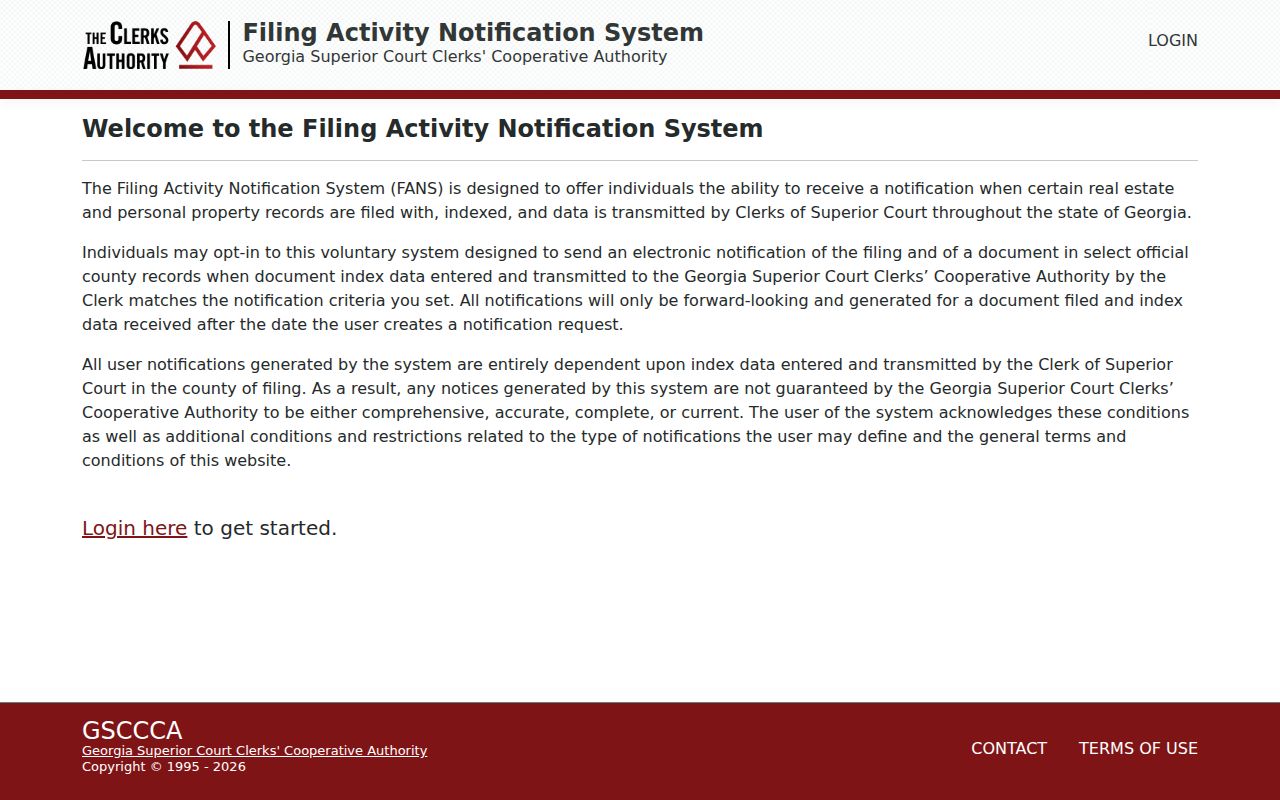
An alert is only a prompt to inspect a filing. It is not title insurance or proof that ownership changed.
Confirm the Current Appling County Owner
Start with the roll as the current-owner card. Then confirm it with the newest matching deed.
- Search Appling qPublic by address and copy the parcel details.
- Use GSCCCA Name Search with County set to APPLING and the roll owner as Grantee.
- Compare the newest deed's grantee, date, legal description, and book/page.
- Resolve entity or estate authority only after the parcel match.
- Vesting
- How the deed names the recipient.
- Grantee
- The party receiving the interest.
- Registered agent
- An entity contact, not necessarily the owner.
When Appling's Deed and Roll Disagree
A newly recorded deed carries its own conveyance and recording dates. The roll serves a tax year instead. It may still list the prior owner. Check that both records describe the same parcel. Then state the mismatch plainly with dates attached.
Georgia's January 1 rule can leave one person responsible for that tax year. A later deed may name a different current owner. Tax responsibility and title are separate conclusions.
Safe at Home Can Substitute an Address
Georgia Safe at Home launched July 1, 2026. It substitutes a designated address on most public records for eligible participants. Never try to reverse-engineer one.
The program hides residence addresses. It does not affect lawful parcel and deed verification.
Use the Appling Owner Record Within Its Limits
The public mailing field may support a property notice, but it proves nothing about where anyone actually lives. The ownership-method guide covers the broader lookup.
Current-record caution. The roll can lag a recent sale; the newest matching recorded deed is stronger transfer evidence. Never use owner information to harass or target anyone.
Capture the Appling Current Owner Evidence
A current-owner worksheet should capture the qPublic search date, address, parcel number, and ownership text. Add the mailing address, situs, acreage, land lot, district, and any last-sale or deed reference. Keep the valuation year too. It explains why a recent conveyance may be missing from the assessment roll. If the card publishes no last-update date, say so plainly rather than inventing one.
Then record the newest matching GSCCCA instrument. Capture the grantor, grantee, execution date, and recording date. Add the instrument type, book/page, and every land-description field available. A warranty deed, quitclaim deed, deed from estate, foreclosure deed, sheriff's deed, or tax-sale deed can each transfer an interest. Each one does so in a different setting. A security deed, lien, assignment, release, or UCC filing does not automatically replace the owner of record.
Compare at least two property anchors before drawing any conclusion. The parcel number is ideal when present. Land lot, district, acreage, subdivision, block, lot, and plat book/page can bridge the two systems when it is not. This measured record card supports a present-tense answer. It also keeps the work from drifting into the backward history that belongs in a former-owner search.
Reach the Appling Custodians When the Card Is Unclear
The Board of Tax Assessors is led by the Chief Appraiser. The office sits at 69 Tippins Street, Suite 101, Baxley. It publishes 912-367-8108. Call with a specific parcel. Ask about the exact owner field, the assessment year, and the update cycle. One narrow parcel request beats asking the office to explain every record tied to an address.
The Clerk of Superior Court, Marsha Thomas, occupies Suite 103 at the same street address. The office publishes weekday hours of 8:00 a.m. to 5:00 p.m. It works with GSCCCA on real-estate filings. It accepts paperwork by mail or at the counter. For an owner conflict, request the latest deed by book/page or by party and parcel clues. Ask the current copy or certification fee.
Georgia's Open Records Act backs requests for maintained assessment data, maps, and other agency records. Those requests stay subject to exemptions and reasonable charges. Official guidance calls for production within three business days when possible. Otherwise the agency sends a response giving timing and any exemption basis. Ask for the cheapest electronic form. This route preserves access whenever the web portal hides a card. It also works when the portal omits the field needed to verify the current owner.
Do Not Turn Contact Data into Residence Claims
A tax roll mailing address is correspondence data, nothing more. In Appling County it might point to a post-office box. It might also be a business office. It might even be a fiduciary. It can even sit outside the county entirely. That field proves nothing about where the owner of record actually lives. It proves nothing about who occupies the parcel. It proves nothing about who appears at the property day to day.
Safe at Home raises the stakes here. Starting July 1, 2026, participants in that program can list a substitute address on most state and local public records. Property records are included. Does that protection seem to touch a record? Then the lawful ownership finding is the right place to stop. Never try to pierce a protected address.
A careful present-owner check keeps ownership and occupancy apart. The assessment roll may name someone who lives elsewhere. The newest deed could belong to a trust or a company. Quote the record's exact wording. A parcel search answers who holds title, not who is inside the home. For notices tied to the land, rely on the public mailing route. You can also use professional service methods suited to the matter.