
Start an Appling Property Search
The Appling qPublic search is the practical first stop. The Board of Tax Assessors links it as the official entry point. It supports owner, location-address, and parcel-number modes. Local labels and result columns vary by county. So read the screen rather than assuming a generic layout. A sound property search records each query and carries the parcel number forward. Never trust a name or street match alone.
- Enter the full situs address, including the road suffix and any lot or unit. If it fails, try the number and street name separately.
- Open the parcel card and copy the parcel number, ownership entry, situs, mailing address, acreage, and legal description exactly as shown.
- Take the owner name or a cited book and page to the GSCCCA real-estate index. Restrict the county to APPLING.
- Compare the deed's land lot, district, acreage, subdivision, and plat reference with the parcel card.
- Check the Tax Commissioner for bill status and obtain a Clerk copy when the recorded instrument matters.
Appling qPublic Search Fields
The assessor route offers three ways into the same parcel roll. Address search works best when road data is current. Owner search suits a person, estate, trust, or company. Parcel number is the cleanest cross-office key once you have it. Legal-information fields may exist on the qPublic platform elsewhere. Appling County does not publish them as confirmed search options.
| Mode | Input | Use | Local caveat |
|---|---|---|---|
| Owner | Last and first name or entity text | Find parcels tied to a roll name | Exact and partial behavior needs a live check |
| Location address | Street number and name | Identify a known site | Range and street-only results were not confirmed |
| Parcel number | APN as displayed | Return to an exact tax parcel | Preserve hyphens and leading zeroes |
| Legal information | Subdivision, lot, or land data | Possible fallback for old descriptions | Appling controls remain unverified |
Do not assume a generic qPublic field or button exists in Appling County until it appears on the local screen. Field layouts differ from county to county. The official Appling qPublic landing page shows the public entry point the assessor uses for its records. Start there.
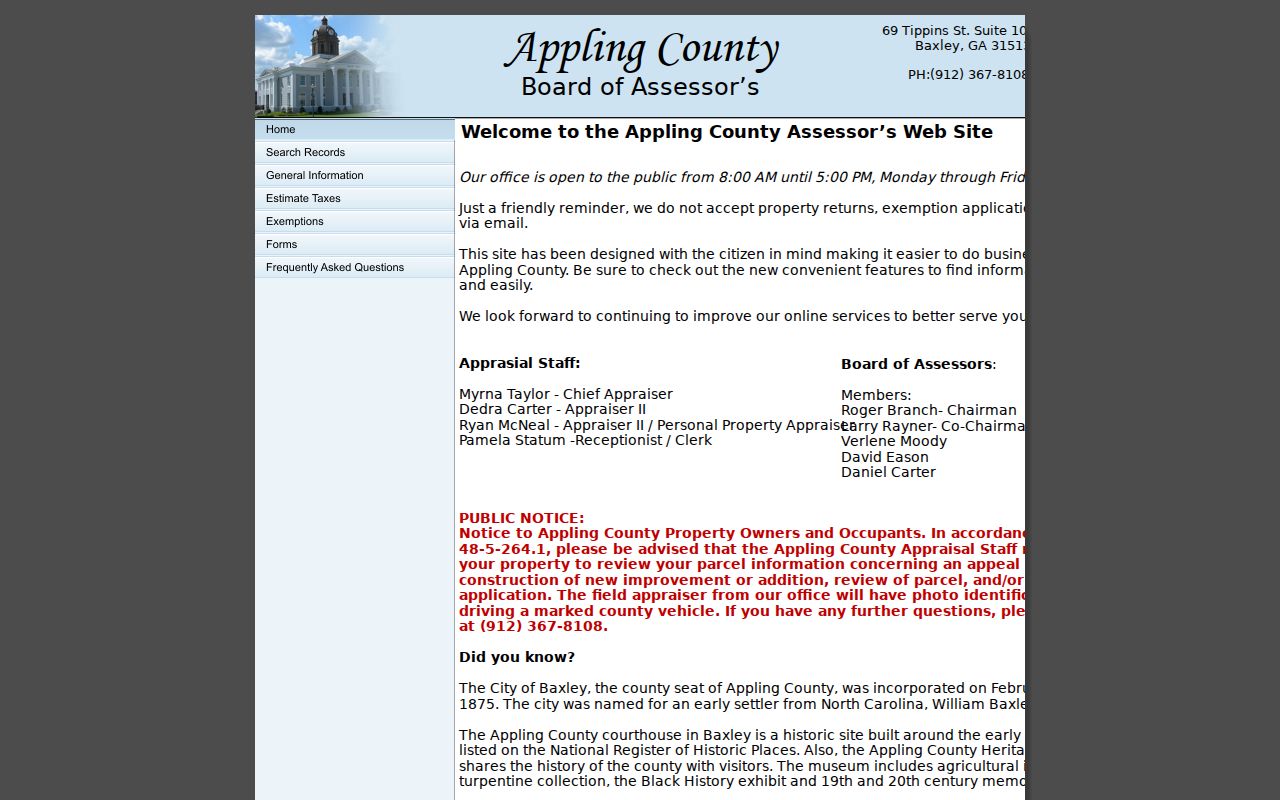
That portal remains the public route to assessor records.
Find Appling Property by Owner
An owner-name property search needs more care than an address search. Try the surname first. Then test initials, punctuation variants, former or married names, and exact legal-entity text. A trust or estate needs special handling. Search the trustee or representative only when the record itself gives that link. A company name on the tax roll is not the same as its registered agent.
Two people can share a name. Require at least two property anchors before treating a result as a match. Good anchors include the parcel number and the situs address. Acreage, land lot and district, subdivision and lot, or a deed book and page also work. That practice keeps the property search tied to land rather than to a person alone.
Entity ownership adds one more step. Copy the company name exactly from the roll, punctuation and suffix included. Then compare it with the deed's grantee text. Georgia's Corporations Division search can confirm an entity name or control number when identity matters. The corporate filing does not prove which real estate the company owns. The parcel and the recorded deed remain the link to Appling County land.
Appling Situs and Mailing Clues
A situs address describes the physical parcel. A mailing address is where the owner receives mail. The two entries may differ without signaling any error. Appling County records give a local example: the Clerk's street address uses the Baxley street ZIP, while its post-office box uses a different Baxley ZIP. Rural routes and post-office boxes create the same split in a property search.
- Situs address
- The location assigned to the land or improvement.
- Mailing address
- The destination used for owner correspondence.
- Parcel number or APN
- The assessor's identifier for a tax parcel.
- Owner of record
- The name carried on the current assessment roll, subject to update lag.
Keep postal city, situs city, county, ZIP, and municipality as separate facts. A ZIP name does not prove that land lies inside city limits.
The distinction matters along rural roads and the small-city edges around Baxley, Graham, and Surrency. City permits or zoning may depend on an incorporated boundary. The same mailing city serves land outside it. Use an annexation instrument or an official city-limit source for municipal status. Neither a ZIP nor the owner mailing line can settle that question.
Read an Appling Search Result
A complete property-search note captures the query and the exact result address. Add the owner of record entry, the mailing address, the parcel number, acreage, and legal-description clues. Value and sale fields help identify the parcel, but they answer different questions. Card labels vary. Copy headings such as Owner, Current Owner, ASV, or Last Sale from the screen rather than predicting them. Note the date you searched.
| Ownership entry | Name and mailing data carried on the roll |
|---|---|
| Situs and mailing | Physical site compared with correspondence address |
| Parcel number | Key used to return to the assessment parcel |
| Value fields | Assessment-year figures, if the local card displays them |
| Legal clues | Acreage, land lot, district, subdivision, block, lot, or plat |
| Sale or deed reference | A lead to verify in the recorded instrument |
Record any update date, map link, exemption, or tax link the card actually shows. None of these fields proves a surveyed boundary or guarantees clear title.
Value fields also need dates and labels. Georgia generally applies a 40 percent assessment level to fair market value before exemptions. A card's assessed value is not interchangeable with a deed's consideration. A tax bill is its own figure, too. Record the year beside each number. That habit keeps an old appraisal from being presented as a current market estimate. A prior sale deserves the same caution.
Land Lots Rescue Appling Searches
A street address is not the only way into Appling County land. Current legal notices lean on land lot numbers. Four of them appear repeatedly in Appling County property records. Those are Lots 293, 332, 426, and 529. Each notice usually pairs the land lot with a district. It may add an acreage figure, a subdivision, or a plat. That pairing matters. It can tie a tract back to its recorded history after a street was renamed, a lot renumbered, or an address dropped from the notice altogether.
Two live examples show the pattern. Fairview Subdivision sits in Land Lot 293 of the 2nd District. Its full key is Block 2, Lots 1 through 12, at Plat Book 1A Page 46. Another trail leads to 5.740 acres in Land Lot 529, 2nd District. That tract sits at Plat Book 22 Page 762. These numbers are working search keys for any property search, not decorative history.
Cross-Check Appling Deed Leads
A property search that turns up an owner or a book/page citation has a natural next step. That step is the GSCCCA name search. Pick APPLING, then grantor or grantee, an instrument type, and a date range. The form stretches further. It accepts neighboring counties, five to one hundred results per page, and three table layouts. Note: a login can stand between an index result and the image itself. An account may be needed to view the deed.
Book/Page Search is simpler, taking county, book, and page. Property Search asks for a subdivision name in participating counties. For the full deed chain, the Appling deed records page keeps instrument types and copy routes in their proper place. Recorder details and deed records indexing sit there too.
Three Appling Record Trails
Local references prove a single search field rarely suffices in Appling County. Each trail pairs a parcel clue with recorded-book data. Treat the newspaper notice only as a lead, then confirm the fact against the Clerk's image or a GSCCCA deed records copy.
- Fairview: match the parcel to Plat Book 1A Page 46 and Deed Book 300 Page 350.
- Forisk tract: compare 5.740 acres in Land Lot 529 with Deed Book 735 Page 143 and Plat Book 22 Page 762.
- Older tract: follow Book 488 Pages 789 through 796 to prior Warranty Deed Book 137 Page 493 and the 1969 survey.
Repeated acreage, district, plat, and book/page links beat a similar owner name every time. They travel well. They also give you a clean written request when an online image will not open.
Search order can shift with what you hold. A platted Baxley lot might start from subdivision and block. A rural tract starts from land lot, district, and acres. A known notice starts from book and page. After identification the workflow never changes. Verify the tract, compare parties and dates, and keep the source behind each fact.
When Appling Portals Stop
Online portals are one channel, not the only one. If qPublic blocks a session, a normal browser may work, or call the Board of Tax Assessors at 69 Tippins Street Suite 101 in Baxley, 912-367-8108. If GSCCCA demands an account or the image is missing, the Clerk of Superior Court takes inquiries at Suite 103, 912-367-8126, during weekday public hours from 8:00 a.m. to 5:00 p.m.
A tight written request under the Georgia Open Records Act beats a vague one. State the parcel, address, owner, year, and the exact fields you want. Ask for electronic records and a fee estimate. For older deeds, courthouse books and the FamilySearch deed and mortgage catalog remain the fallback.
Note: Appling's exact qPublic refresh cycle and the county's GSCCCA good-through date are not published on the official pages.
Choose an Appling Search Key
The best input depends on what you already hold. An address is fast for one occupied site. A name can surface several parcels, but same-name risk creeps in. An APN stays precise inside the tax roll, though splits and mergers shift parcel numbers. A land-lot or plat reference is often the strongest bridge. It reaches deep into older Appling County property records.
| Search Key | Best For | Where It Works | Watch Out |
|---|---|---|---|
| Address | A known physical site | qPublic | Road variants and postal-city mismatch |
| Owner name | Parcels carried under one roll name | qPublic and GSCCCA | Trusts, estates, entities, and same names |
| Parcel number | An exact assessment record | qPublic and office requests | Splits, mergers, and formatting |
| Book and page | A known recorded instrument | GSCCCA and the Clerk | Index entry may omit the full description |
Not a title search. An Appling County property search finds public assessment and recording clues. It does not establish clear title or replace a lawyer, title professional, deed image, or survey.
Keep a search log. Record the date, query, source, result, and the next deed or plat reference it points to. That habit makes a multi-portal property search reproducible. It also shows when two sources refreshed at different times.
Spelling matters in every system. GSCCCA wants a last name first for individuals. qPublic starts from the assessment roll's own text. A failed match may come from punctuation, initials, an entity suffix, or a date range rather than a missing record. Change one input at a time. Note the result count. Return to the parcel anchors before accepting a candidate owner of record.
When a query returns nothing, keep the failed terms in the log. That record shows the Clerk or assessor exactly which address, name, parcel, subdivision, land lot, and date variants you already tested.
A retained search date also exposes later portal changes. If a field or result differs on a return visit, save the new version. Then ask the custodian which record reflects the controlling assessment or recording date. The tax bill and the deed records may simply follow different clocks.